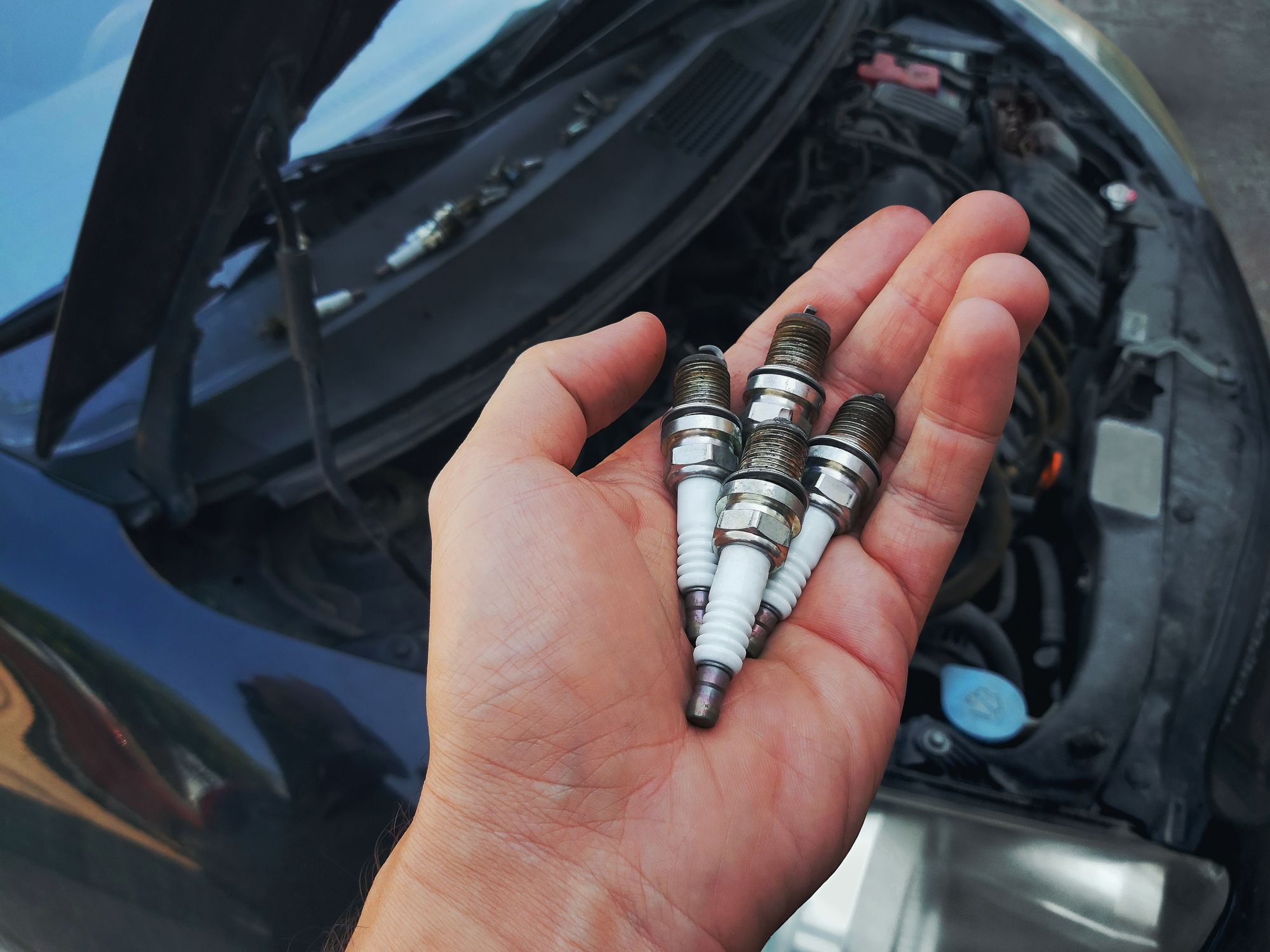
Spark plugs don’t ask for much attention, but ignore them, and your engine will let you know there's a problem. These small parts sit right at the center of the combustion process. When they’re doing their job, your engine likely feels smooth, responsive, and efficient. When they’re not, everything from fuel efficiency to driveability may start to slip.
Whether you’re here for basic know-how or specific troubleshooting, you’re in the right place. This is Spark Plug 101, where we’ll cover how often to replace spark plugs and wires, what they do and how they work, and how to tell if spark plugs need replacing.
Key Takeaways:
- It’s always best to check your owner’s manual, but most modern spark plugs typically last between 20,000 and 100,000 miles, depending on their type and how the vehicle is driven.
- Rough idle, engine misfires, poor acceleration, difficulty starting, reduced fuel efficiency, and a check engine light are all common symptoms of bad spark plugs.
- Spark plug replacement boils down to a few key steps: access the plugs, remove them carefully, gap the new plugs, install them with the correct torque, and reconnect everything as it was before. However, the ease of replacement varies by vehicle. Some are more straightforward, while others require specific tools and techniques.
- It’s crucial to install spark plugs with precision. Improper torque or incorrect gapping can lead to performance issues and even engine damage.
What are Spark Plugs and How Do They Work?
Your engine depends on controlled explosions. The combustion process relies on a precise mix of air and fuel, ignited at the right moment in the combustion chamber. That process starts with voltage. Your ignition coil generates high voltage and sends it to your spark plugs, either through a distributor and spark plug wires or directly through a coil-on-plug system. At the tip of each spark plug, that voltage jumps a small gap, creating an electrical arc inside the combustion chamber that ignites the fuel-air mixture.
When that spark is strong and consistent, the combustion process stays controlled. The engine is running smoothly, with steady power and good fuel efficiency. But over time, heat and pressure wear down on your plugs’ electrodes, widening the gap and weakening the spark.
A worn electrode or a faulty spark plug can lead to incomplete combustion. Fouling from oil deposits (often associated with worn valve guides) or excess fuel can make things worse, even if the plugs aren’t that old.
How Often to Replace Spark Plugs
Not all spark plugs are created equally. So, if you’re trying to determine if your spark plugs are past their prime, start with the type of plug your engine uses:
- Copper: About 20,000 miles
- Platinum: About 60,000 miles
- Iridium: About 100,000 miles
That said, your owner’s manual is still the authority. It accounts for how your specific engine manages heat, fuel delivery, and ignition timing. Real-world driving matters just as much. If your vehicle spends most of its time in traffic, on short trips, or idling, your plugs may be working harder than the mileage alone suggests. In cases like these, replacing them a bit early isn’t overkill, but instead, a crucial preventative maintenance task that can protect fuel efficiency and keep your engine healthy for as long as possible.
Signs Spark Plugs Need to Be Replaced
When a spark plug fails, it might not show up as an immediate, dramatic failure, especially in modern vehicles. Unfortunately, that doesn’t mean you don’t have to worry about it. In time, faulty spark plugs can cause catastrophic damage. So, if you think your vehicle may have spark plug-related issues, watch for these symptoms:
- A check engine light tied to ignition faults
- A longer crank before the engine starts
- A rough idle that wasn’t there before
- Slower, less confident acceleration
- Subtle or consistent engine misfires
- A steady decrease in gas mileage
Ultimately, if you pull a plug and see a worn electrode, heavy carbon deposits, or oil fouling, you’ve got confirmation: your plugs need replacing.
How to Replace Spark Plugs
At this point, you’re probably wondering whether replacing spark plugs is a DIY job or something better left to a professional. The answer is both, depending on your vehicle. Some engines have easy-to-access spark plugs, while others can require special tools and techniques. Still, here’s a basic guide to spark plug replacement:
Step 1: Prepare for the Job
Start with a completely cool engine. Disconnect the battery and gather the right tools: a spark plug socket of the correct size, a ratchet, an extension (if needed), a torque wrench, and a gap gauge.
Step 2: Locate the Spark Plugs
Most engines have one spark plug per cylinder. Depending on the layout, they may be easy to access or buried beneath other components. In the case of the latter, we recommend taking your vehicle to a professional for replacement.
Step 3: Remove Wires or Coils
Modern engines typically use coil-on-plug systems, while older systems rely on spark plug wires to carry the voltage. Whichever system you have, remove your wires/coils one at a time or label them per cylinder to avoid mixing them up.
Step 4: Remove the Old Plugs
Attach an appropriate spark plug socket to the end of your ratchet, using an extension if necessary. Turn it counterclockwise to remove each spark plug. Take your time, and if things feel uncomfortably tight, take your vehicle to a professional — damaging threads in a cylinder head is a costly mistake you don’t want to make.
Step 5: Gap the New Plugs
While most new plugs are gapped to a basic specification, they aren’t always perfect for your engine out of the box. Use a spark plug gapping tool (available at most auto stores) to ensure the spacing matches your vehicle’s manufacturer's specifications so the plug can properly ignite the fuel.
Step 6: Install the New Plugs
In a clockwise fashion, thread the new, gapped spark plug into the cylinder head by hand first. Then tighten it to the correct torque specification, which varies by engine (this specification may be found in your owner’s manual, but is often in a repair manual for your vehicle/engine). This step matters: too tight, and you might damage the threads — too loose, and performance can be compromised.
Step 7: Reassemble the System
Reconnect the ignition coil or the spark plug wire, then repeat the process for each cylinder.
How to Replace the Spark Plug Wires or Coils
Sometimes, ignition problems aren’t due to a faulty spark plug, but rather, a bad coil or spark plug wire. If your engine is running rough even after replacing your spark plugs, there’s a good chance your spark plug wires or coils are to blame. Firestone Complete Auto Care technicians can help you replace these, but if you’re a DIYer, here’s how you can replace your spark plugs, according to each type of ignition system:
Replacing Spark Plug Wires (Older Vehicles)
Older ignition systems use a spark plug wire to carry voltage from a single ignition coil and distributor to each plug. When a spark plug wire starts to break down (due to age or malfunction), it can weaken the spark before it reaches the spark plug. Here are the basic steps for replacing spark plug wires, once you’ve obtained a new set for your engine:
- Disconnect the battery. Better to be safe than sorry!
- Work one wire at a time. This prevents mixing up the firing order, which can cause engine misfires.
- Match the new wire to the old one. Length and routing are essential here; keep it as close as possible to the original setup if you’re using a cut-to-length wire set.
- Remove the old wire carefully. Pull from the boot, not the wire itself, to avoid damage.
- Securely install the new wire to the distributor and spark plug. You should feel or hear it click into place at both ends.
- Check your routing. Ensure that your wires are clipped in place and kept away from any hot or moving components (such as exhaust manifolds or radiator fans).
Replacing Coils in a Coil-on-Plug Setup (Modern Vehicles)
Modern engines typically use a coil-on-plug system, where each spark plug has a dedicated ignition coil mounted directly on top of it. There are typically no traditional spark plug wires — each coil delivers voltage straight to the plug. When one of these coils starts to fail, the symptoms often mirror worn spark plugs. While procedure varies by make/model, here are the basic steps for replacing a bad ignition coil in a modern vehicle:
- Disconnect the battery. This protects you and the vehicle’s electrical system.
- Locate the faulty coil. Diagnostic trouble codes can help pinpoint the exact cylinder of the failed coil.
- Unplug the electrical connector. Depress its tab and pull on the connector gently. Don’t pull from the wires — you don’t want to damage them during this step.
- Remove the mounting bolt, if applicable. Most coils are held in place by a single bolt. Put the bolt somewhere safe for reinstallation later.
- Pull the coil straight out. A slight wiggle may help break the seal.
- Install the new coil. Seat it firmly over the spark plug, then secure the bolt and reconnect the electrical connector.
Firestone Complete Auto Care Tip: Unlike spark plugs, coils are often replaced individually as they fail. Still, if one goes out and the others are original with high mileage, it’s worth keeping an eye on the rest.
Spark Plug Replacement FAQs:
How Hard Is It to Replace Spark Plugs?
Some engines make it easy. Others don’t. If the plugs are on top or on each side of the engine, this can be a straightforward job with basic tools. If they’re buried or if access requires removing other components, it becomes more involved.
The difficulty is doing it right: the correct gap, the correct torque, and no damage during removal or installation. When in doubt, there’s no shame or downside in having it handled professionally.
How Much Does It Cost to Have Spark Plugs Replaced?
There’s no flat rate for spark plug replacement. The cost is shaped by a few key factors: the type of spark plug, the number of plugs in your engine, and how easy the plugs are to access. Still, in general, here are some basic estimates:
- For a 4-Cylinder: Between $100–$250
- For a 6-Cylinder: Between $150-$350
- For an 8-Cylinder: Between $200–$500+
Restore the Spark with Firestone Complete Auto Care
Replacing spark plugs involves proper tools, correct torque specifications, and careful handling of ignition components. Firestone Complete Auto Care offers engine services that include spark plug replacement and inspection of ignition coils, wires, and related components. If your vehicle is showing signs of worn spark plugs, a professional inspection and replacement may be the better choice. Visit your local Firestone Complete Auto Care to ensure your spark plug replacement is done properly.
--
Article Development Supported & Reviewed By:
Firestone Complete Auto Care’s Technical Operations Team
The Firestone Complete Auto Care’s Technical Operations Team is composed of ASE certified technicians with over 70 years of combined experience. ASE certification represents the highest standard of technical training in the automotive industry. Guided by Firestone Complete Auto Care’s rigorous editorial standards, our team delivers timely, detailed, and practical resources drivers can trust to keep their vehicles running newer, longer.